Language
Quick answer: does red light help horse tendons and ligaments?
PBM can be a useful adjunct, not a stand-alone cure. In equine rehab it is most often used to:
· Support collagen organization and lesion remodeling in tendons/ligaments
· Reduce peri-tendinous edema and local inflammatory mediators
· Improve comfort during controlled exercise programs
· Maintain muscle condition and topline recovery in performance horses
A 2019 review described PBM as a “promising adjunctive treatment” for equine tendon and ligament injuries, while noting that standardized protocols are still limited across the industry. Class IV laser case series have reported shortened ultrasound-visible healing and lower re-injury ranges versus conservative historical controls, but many protocols use high-power laser parameters that differ from at-home LED pads. For wholesale LED products, the honest position is: sell PBM as a rehab-support tool, always paired with veterinary diagnosis, ultrasound monitoring, and controlled exercise.
How photobiomodulation works in horses?
Red/NIR photons are absorbed primarily by mitochondrial chromophores such as cytochrome c oxidase. The downstream effects relevant to equine soft tissue are:
Increased ATP production → better cellular repair capacity
Nitric oxide release → vasodilation and improved local perfusion
Modulated cytokines (e.g., lower IL-1β/TNF-α-type inflammatory signaling) → less chronic inflammation
Fibroblast stimulation → collagen synthesis for tendon/ligament matrix
Improved collagen alignment in healing tendon when used in structured rehab
Because tendon and ligament have relatively poor blood supply, any modality that supports local circulation and organized collagen formation can be valuable—provided it does not replace rest, loading protocols, or imaging-based progression.
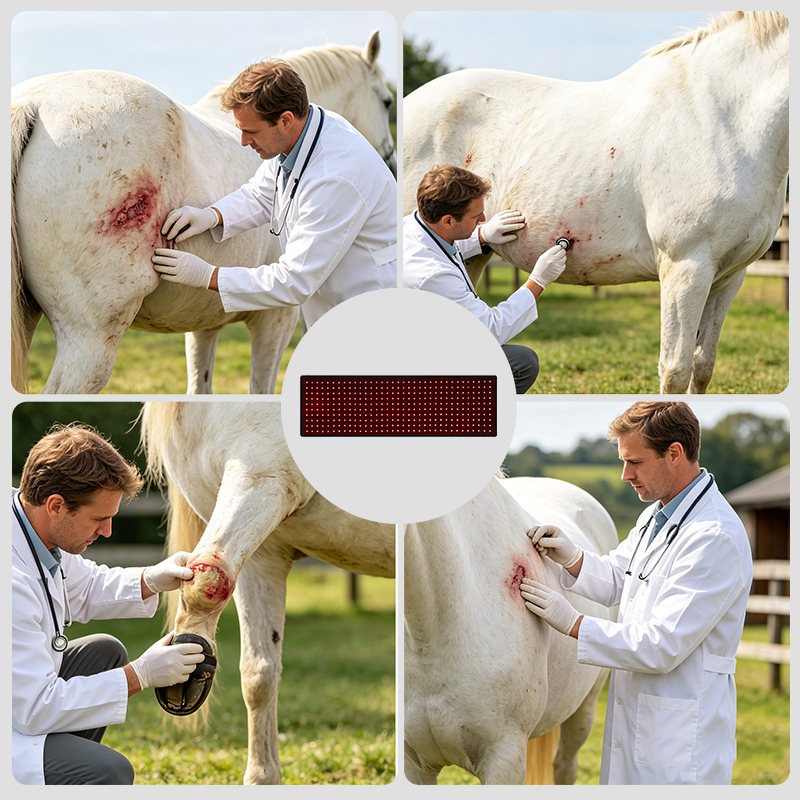
Wavelength selection for equine use
| Band | Typical role in horses | Best use |
| 630–660 nm red | Superficial skin, wound margins, surface inflammation | Cuts, abrasions, post-surgical skin, light superficial inflammation |
| 810–850 nm NIR | Deeper muscle, tendon, ligament, joint capsule | SDFT/DDFT, suspensory, back musculature, hock/stifle support |
| 905–980 nm (laser systems) | Deeper thermal/vascular effects in clinical lasers | Clinic-only high-power protocols, not typical home LED |
For most horse LED pads/wraps, a 660 nm + 850 nm dual-band configuration is the commercial sweet spot: red for surface, NIR for deep soft tissue. Some veterinary lasers add 810/905/980 nm, but those are not directly comparable to consumer LED irradiance.
Performance recovery for sport, race & working horses
Beyond injury, PBM is used in training-periodization programs:
· Post-training muscle recovery: 12–18 min per major group (back, hindquarter, shoulder); supports reduced DOMS-like stiffness and lactic-acid clearance in human analogs; equine use is experiential but common in dressage/jumping/eventing
· Pre-event prep: short low-dose sessions to support local circulation and tissue elasticity; avoid excessive heat before maximal effort
· Travel/trailer fatigue: full-pad or blanket sessions in stable to relax topline and legs
· Preventive maintenance: 3–5×/week during hard blocks for horses with prior soft-tissue history
A cross-species performance guide suggests 10–15 min per human muscle group and 12–18 min per equine major muscle group post-training; total horse sessions often run 45–90 min if covering back, hindquarters, shoulders, and legs separately.
KR-series / OEM mapping for equine wholesale
For distributors targeting vet clinics, race/performance yards, and e-commerce pet-horse brands:
· KR120 / KR160: 660+850 flexible pads; good for small-leg wraps, localized tendon spot work, pony/calf-size backs when used in multiples. KR120 ~40×20.9 cm, KR160 ~53×21 cm. Best as entry vet-clinic demo or dog+horse-leg crossover SKU.
· KR350: large flat pad ~89×27.9 cm, high-output NIR-capable configuration; suitable for saddle area, hamstring/glute region, shoulder, or multiple leg placements. For full horse back, use one or more KR350 strips under a stable blanket or custom OEM full-back mat.
· Custom equine blanket/pad (OEM): 1,600+ mm full-back formats, 660+850 tri/dual-chip, 4-zone control, SBR waterproof shell, rechargeable battery packs; target rehab centers and competition stables.
· Horse boot/wrap line: 660+850, 50–100 mW/cm² verified, 45–60 min battery, adjustable straps; MOQ and logo customization for resellers.
All B2B units should ship with: irradiance test report, wavelength sheet, CE/RoHS/FCC docs, user protocol template (J/cm² calculator), and veterinary disclaimer.
Why Choose Kinreen Factory for Hand-Focused Devices?
As a 19-year OEM/ODM manufacturer, Kinreen integrates NASA-inspired wavelengths with medical-grade components. Our gloves feature dual-chip LEDs (660nm red + 850nm NIR) for deep-tissue penetration, FDA-cleared safety, and ergonomic designs validated by 10,000+ hours of clinical testing.
For those seeking to buy red light therapy tools, explore our NSF-certified devices at kinreen.com, offering factory-direct durability and a 30-day satisfaction guarantee.

Kinreen red light therapy supplier is a professional SGS-verified factory manufacturing Led therapy lights.